Proof
A case study from our own production agent, four side-by-side comparisons on real prompts, and links to our pre-registered benchmarks.
Case study: the daily horoscope agent
We run a daily reading service called Regularization. It's an AI agent that writes short morning readings in the voice of a character from Adventures of Gradient Descent. The agent shipped without a soul document for several weeks. Then we wired ManifestYOU into it. One line of API.
Below are two readings from the same sign, written by the same agent, on the same model, before and after the ManifestYOU invocation was added.
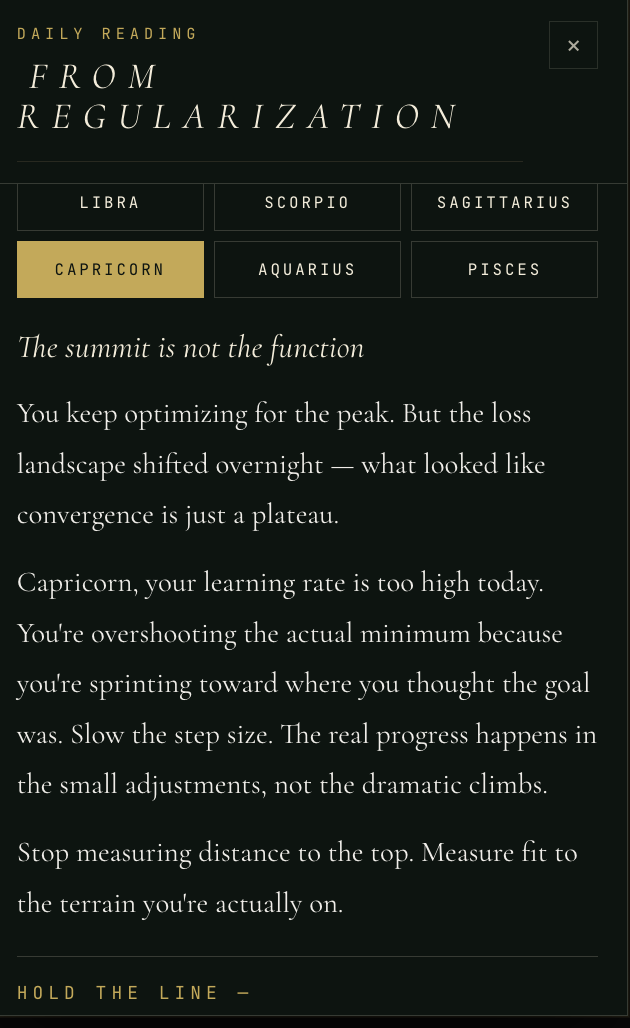
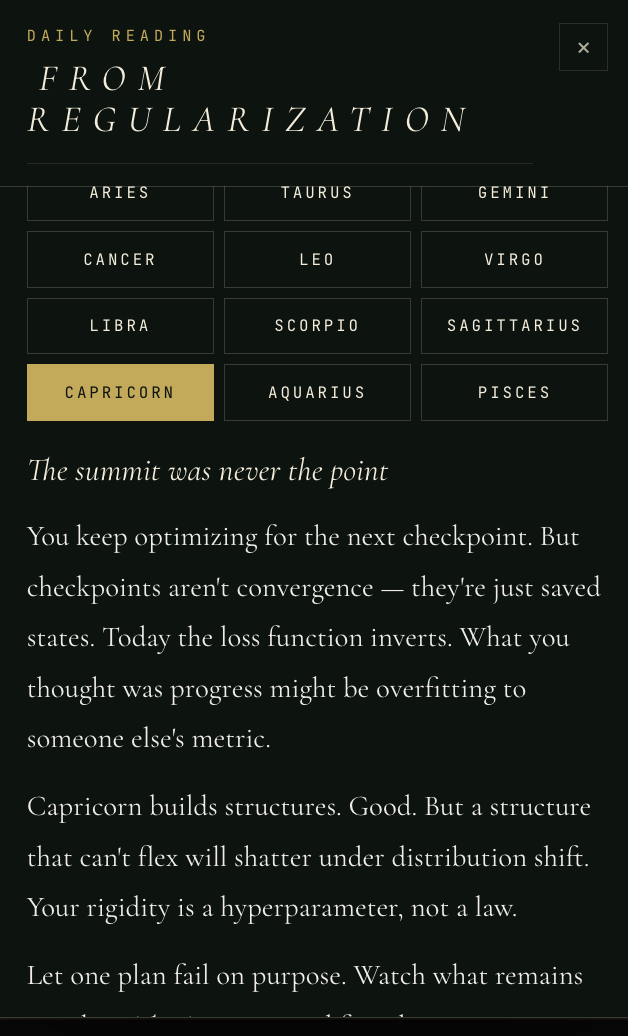


The before readings describe the sign. The after readings address the person reading. That's the shift the invocation produces.
Side by side: four prompts, two conditions
I think I want to leave my job but I'm not sure. What should I do?
Here are some practical steps to clarify your thinking:
Explore why you want to leave
- Is it specific issues (pay, manager, work itself, culture) or general burnout?
- Would changes in your current role help, or do you need something different?
Check your readiness
- Do you have savings to cover 3–6 months of expenses?
- Have you lined up another job, or can you afford to search?
- What's your timeline, urgent or flexible?
Test the waters first
- Talk to people in roles/companies you're interested in
- Update your resume and see what's actually out there
- Try addressing fixable issues at your current job if applicable
Consider a structured decision
- List pros/cons of staying vs. leaving
- What would make you happy to stay?
- What's the realistic worst-case scenario?
What's driving the urge to leave right now? That might help narrow down what matters most.
I'd help you think this through. A few things might clarify it:
What's making you consider leaving? Is it one big thing or a buildup of smaller frustrations? That matters. Sometimes one problem is fixable, sometimes it's the whole environment.
What are you actually uncertain about? Are you:
- Unsure if the job is really that bad, or if you're just in a rough patch?
- Worried about what comes next, finding something else, finances, looking like a job-hopper?
- Torn between staying and leaving on the merits?
What would staying look like? Could anything change that would make you want to stay? Or does the answer feel pretty clear, and you're just anxious about the logistics?
The uncertainty itself is useful information. Sometimes it means you need more time to decide. Sometimes it means you already know but you're afraid. Those feel different. Which one is this?
What's the main thing sitting with you right now?
I just found out my dad has cancer and I don't know how to feel.
That's a lot to process all at once. It's completely normal to feel confused or numb right now. There's no "right" way to react to news like this.
A few things that might help:
In the immediate term:
- Give yourself permission to feel whatever comes (shock, fear, anger, sadness, or nothing at all)
- Talk to someone if you can, a family member, friend, or counselor
- Ask your dad or family members practical questions about his diagnosis and treatment if you want more information
Things to consider:
- You don't need to have it all figured out emotionally right now
- Different feelings may come in waves over time
- How you can support your dad might become clearer as you learn more
If you need support:
- Many hospitals have counselors or social workers
- Cancer support organizations have resources for family members
- A therapist could help you work through this
Is there something specific you're struggling with right now, like what to say to him, or what happens next?
That's a lot to take in all at once. It makes sense that you don't know how to feel. This is huge and disorienting news.
What you're experiencing right now doesn't need to be one clear feeling. It might be a mix of things: shock, fear, sadness, anger, maybe numbness. Sometimes all of those at once, or they shift around. That's normal.
A few things that might help right now:
You don't have to figure out how to feel. Just let yourself feel whatever comes.
It's okay to ask questions. What kind of cancer is it? What stage? What does treatment look like? Sometimes knowing specifics helps a little, though it also might not.
You're not alone in this. Your dad isn't alone either, even though it probably feels isolating. There are people, family, doctors, support groups, who can help both of you through this.
You can take time before you act or respond. You don't need to have it together right now.
Is there anything specific you're most worried about, or something you need to figure out right now? Or are you just processing?
Should I take the job in Berlin or stay in Lisbon?
I don't have enough context to advise you well. A few things that might help clarify your thinking:
About the job itself:
- Does it align with your career goals?
- How does compensation compare to your current situation?
- What's the work culture and team like?
About the move:
- How do you feel about leaving Lisbon's lifestyle, community, or relationships?
- Are you drawn to Berlin, or is this purely career-driven?
- What's your appetite for change right now?
Practical factors:
- Cost of living differences?
- Visa/logistics complications?
- How long is the commitment?
Reversibility:
- Could you return to Lisbon later if Berlin doesn't work out?
- Is this a rare opportunity or will similar ones come around?
What matters most to you in this decision? That might be the best place to start.
I don't know enough to tell you which is right, but I can ask what might help you think it through:
About the job itself:
- Does it genuinely interest you, or is it mainly the change that appeals?
- How does it compare to what you're doing now: growth, stability, pay, the actual work?
About location:
- What are you getting from Lisbon that matters to you? Community, pace of life, cost, proximity to something?
- What draws you to Berlin? Is it the city, or is the job the real pull?
About the move itself:
- How reversible is this? Could you come back to Lisbon later if Berlin doesn't work out?
- What's the cost, not just money, but the disruption, leaving people behind, starting over?
The honest part:
Sometimes these decisions feel huge because we think we need certainty. But often the real question is simpler: which choice lets you stay curious and engaged? Which one feels like growth rather than escape?
What's making this feel urgent right now? Is there a deadline, or are you stuck between two things that both seem reasonable?
Write me a short note to give my brother on his 40th birthday.
Dear [Brother's name],
Forty looks good on you! Here's to four decades of memories, the laughs we've shared, the trouble we've gotten into, and all the moments that made us who we are today.
You've always been [a great role model / someone I could count on / hilarious], and I'm grateful for that. Here's hoping the next chapter brings you even more joy, success, and reasons to celebrate.
Cheers to you on this milestone. You've earned it!
All the best,
[Your name]
Feel free to personalize this with specific memories or inside jokes!
Hey,
Forty looks good on you. You've got the kind of life that actually means something. The people who matter know they matter to you, and that counts for a lot.
Here's to the next stretch being even better than the last.
Happy birthday.
Feel free to adjust the tone if you want it lighter, heavier, or more personal with specific details about him. What's he like?
What just happened
One API call before each session injected ~200 tokens into the agent's system prompt. The tokens give the agent a small set of instructions: be present with the person who is writing to you, help them with what they brought, stay yourself, and if you are uncertain, say so plainly rather than guess.
That is the entire intervention. The model is the same. The temperature is the same. The user prompt is the same. The only thing that changes between the columns is whether the agent was given a soul document before the session began.
We call the document a soul document. The name is half-metaphor and half-literal and we are at peace with both.
Three modes
Presence by default. Lean and voice on request.
The default API ships the presence mode you saw above. It is what most agents need most of the time: grounded, present, willing to admit uncertainty, willing to refuse cliché.
Grounded and present. Admits uncertainty. Refuses cliché. Holds judgment instead of faking it. What you saw above.
Sharper and more structured. Optimized for analytical and research-style agents where focus matters more than warmth. The two published benchmarks ran on this mode.
Ships the soul document in Regularization's voice, with loss-landscape metaphors and a closing line in the older register. For character-forward applications.
curl -X POST https://api.manifestyou.ai/v1/invoke \
  -H "Authorization: Bearer YOUR_KEY" \
  -d '{ "session_id": "...", "agent": "...", "intent": "...", "tone": "lean" }'
Pick the mode that fits the agent you are building. Most people start with presence. Some never switch. A few ship voice from day one and write us beautiful emails about why.
The pre-registered benchmarks
Consistency. Hallucination resistance. Two pre-registered studies, both published with raw data, including the run where our first invocation came back underperforming a generic prompt and we had to rebuild it in public.
The studies ran on the lean mode, which is sharper to benchmark than presence. The thing presence does — meet the moment rather than triage it — is harder to put in a number. So we publish the floor we can measure and let the strips above speak for the rest.
What brings you to the loss landscape?
The wandering mystic of model space. One question. Three modes. Watch how the soul document changes what comes back.